

 (AGENPARL) - Roma, 2 Settembre 2026 - How investments, climate-smart practices and singing help one Mongolian dairy farmer get the most from her cows
©EBRD
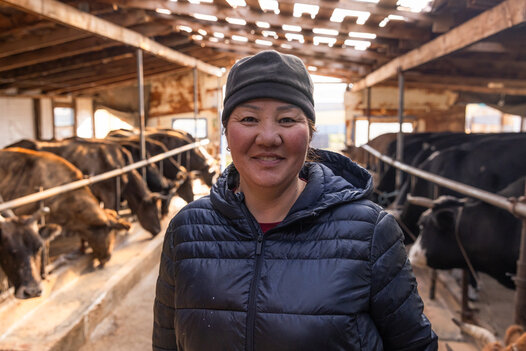
When Otgo Dashdorj milks her cows in the pre-dawn cold of the Mongolian steppe, she sings. Her husband sings too, their voices rising in the dark above the low breath of the animals. "I am happiest when I sing with my husband while milking our cows," she says with a laugh.
The singing, it turns out, is not incidental. Otgo knows what any experienced herder knows: calm cows produce more milk. But the calm she works to sustain is harder won than it once was. Drought and rising costs have reshaped what it means to farm dairy in Mongolia.
Otgo is one of more than 1 700 farmers from the country's Töv province who supplies raw milk to APU Dairy, part of one of Mongolia's oldest and largest beverage producers.
Before this undertaking, she and her husband were nomadic pastoral herders for 27 years, a traditional way of life for many rural Mongolians.
But the winters are harsh, the summers are dry, and grasslands are consistently degrading by overgrazing and climate change. Increasingly difficult to predict weather makes it even harder for nomadic herders to reach good pasture and water come spring.
So, three years ago, Otgo and her husband made a deliberate shift: settling into livestock husbandry—building fixed infrastructure and managing their herd year-round from a single location, rather than following the seasonal pasture cycle.
With their dairy farm now well-established, they plan to grow their business, eventually doubling their herd to 40 dairy cows.
And they intend to transition into a fully equipped cluster farm, which pools resources with other small-scale dairy farmers and shares infrastructure such as milk collection, cooling and veterinary services. Increasingly popular in Mongolia, cluster farms are an innovative concept that can help stabilize milk supply and sustain year-round production.
Supported by funding from the Government of Canada as part of the High-Impact Partnership on Climate Action (HIPCA), the Food and Agriculture Organization of the United Nations (FAO) through its Investment Centre and the European Bank for Reconstruction and Development (EBRD) are working with APU Dairy and the Dairy Development Board of Mongolia to provide technical assistance to Otgo and other local dairy farmers. The initiative aims to improve farm efficiency, sustainability, and resilience to climate change.
"The changing of the four seasons creates different sets of risks and added costs for managing our herd," Otgo explains, "but winter is the toughest."
"Last year was better," she adds, "but the year before that, we had snow reaching the top of our fences."
Otgo was referring to the dzud, a slow-onset weather phenomenon unique to Mongolia marked by extreme cold, deep snow, impenetrable ice cover and scarce grazing resources.
The 2023–2024 dzud, one of the most severe in years, caused over USD 820 million in estimated economic damages and losses to the livestock sector nationally.
That data formed the basis of a monitoring, reporting and verification system that tracks sustainability performance over time. It also informed the FAO-developed investment blueprints and a dedicated e-extension app that is based on the FAO's Digital Service Portfolio.
Mongolian dairy farmers can access this app for advice on formulating the feed ration for milk production or adopting low-emission, climate-smart practices, such as transitioning to high-quality feed and drought-resistant forage that can ease pressure on grazing lands. or.