 (AGENPARL) - Roma, 4 Dicembre 2024 - (AGENPARL) – mer 04 dicembre 2024 Le ragioni di una mostra
Firenze, Antica Canonica di San Giovanni, Libreria Brunelleschi
5 dicembre 2024 – 31 marzo 2025
A cura di / Curated by
Vincenzo Circosta
Giuseppe Giari
Testo di / Text
Timothy Verdon
Area Relazioni Esterne
External Relations Area
Antonella Chiari
Mónica Serrano Segui
Ufficio Stampa / Press Office
Ambra Nepi
Video
Klimentina-Maria Nedelcheva
Realizzazione grafica e allestimento
Layout and Display
Stampa In Stampa
opera di santa maria del fiore
Consiglio di Amministrazione
Board of Directors
Luca Bagnoli, Presidente
Sergio Givone
Giacomo Manetti
Domenico Mugnaini
Antonio Natali
Andrea Simoncini
Vincenzo Vaccaro
Direttore Generale
Director
Lorenzo Luchetti
The reasons for an exhibition
La fotografia è sempre una questione di
distanza. La distanza delle lenti dell’obiettivo,
che avvicinano o allontanano il soggetto; la
posizione stessa del fotografo che sceglie il
punto di ripresa, determinando la distanza dalla
scena che vuol rappresentare: Robert Capa, il
più noto tra i reporter di guerra, affermava che
«se le tue foto non sono abbastanza buone, vuol
dire che non sei abbastanza vicino». Nelle foto
di Lilyana il tema della distanza ha una
declinazione ancora diversa. La fotografa ha già
chiara la posizione dove stare, il cavalletto è
stabile e non si sposterà. La distanza qui è tutta
metafisica e ci parla del ruolo stesso dell’opera
d’arte quando si confronta col divino: l’artista è
medium attraverso il quale la distanza tra Terra
e Cielo, tra Uomo e Dio, si ravvicina.
Photography is always a matter of distance. The
distance of the lens elements, which bring the
subject closer or push it further away; the
photographer’s own position, choosing the
viewpoint and determining the distance from the
scene they want to represent: Robert Capa, the
most famous of war photographers, claimed that
‘if your photos are not good enough, you’re not
close enough.’ In Lilyana’s photos, the theme of
distance takes on a different nuance. The
photographer already knows where to position
herself; the tripod is stable and will not move.
Here, the distance is entirely metaphysical and
speaks to us of the role of the artwork when
confronting the divine: the artist is the medium
through which the distance between Earth and
Heaven, between Man and God, is shortened.
giuseppe giari
Progetto in collaborazione con
Project realized with the collaboration of
National Fund for Culture of Bulgaria
Sofia Municipality Culture Programme
tracce 5. a cura di Antonio Natali
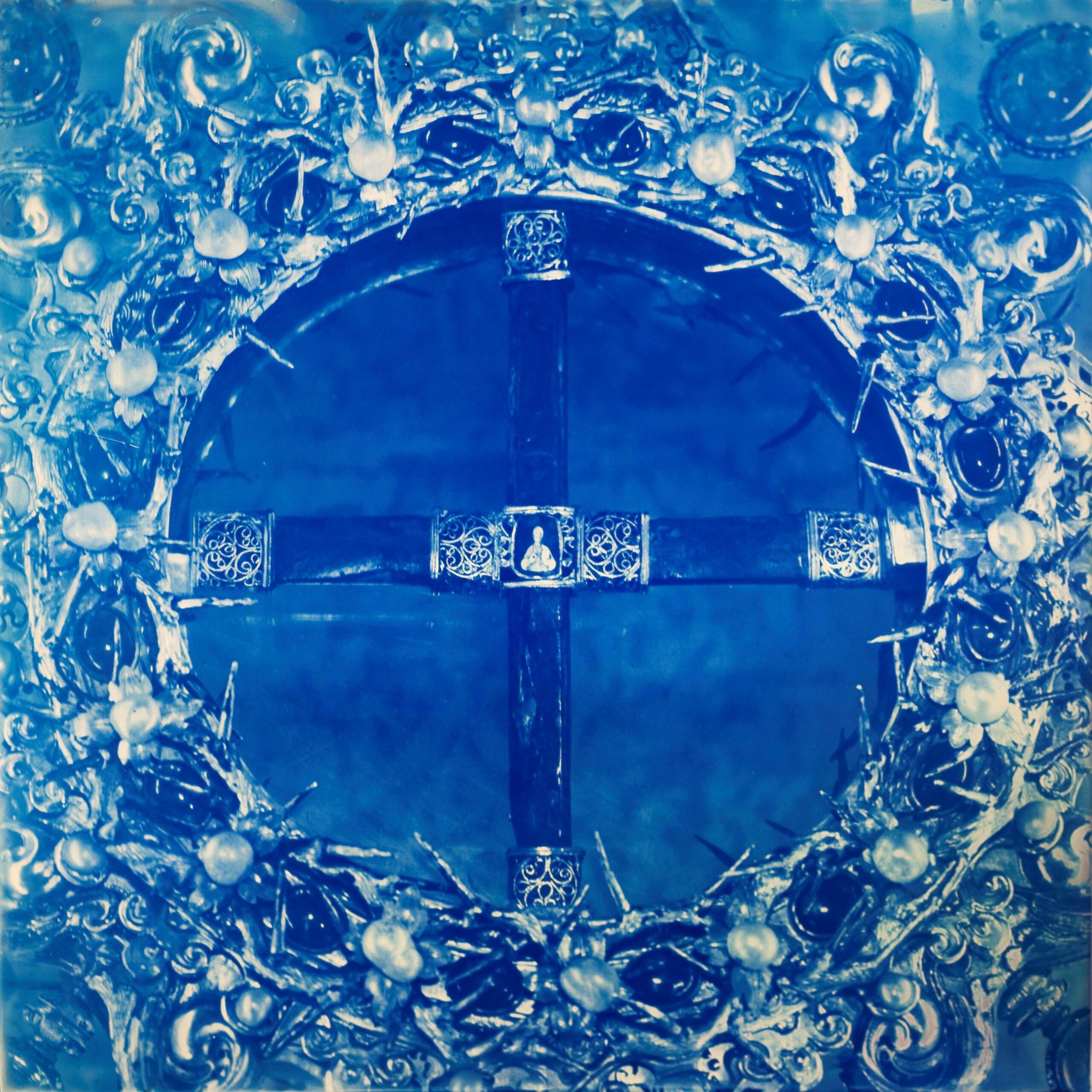
L’approccio fotografico di Lilyana Karadjova è un
approccio antico al limite dell’ancestrale. Il suo
lavoro dedicato alle reliquie dei Santi, conservate
nel Museo dell’Opera del Duomo di Firenze,
indaga con occhio atavico i sacri reperti. La sua
indagine visiva sembra riecheggiare i supplizi dei
dipinti seicenteschi di Jusepe de Ribera e Giovan
Battista Langetti, interpretandoli in maniera del
tutto personale. Usando l’antica tecnica della
cianotipia, Lilyana stampa su vetro immagini
uniche, al limite dell’artigianale, un supporto
desueto e fragile come fragili appaiono i
frammenti ossei fotografati che, per processo
chimico, assumono un colore blu a ricordo tangibile del Regno Celeste.
vincenzo circosta
Lilyana Karadjova’s photographic approach is an
ancient one, bordering on the ancestral. Her work
dedicated to the relics of the Saints, housed in the
Museo dell’Opera del Duomo in Florence, explores these sacred artifacts with a primal eye. Her
visual investigation seems to echo the agonies of
the 17th-century paintings by Jusepe de Ribera
and Giovan Battista Langetti, interpreting them
in a completely personal way. Using the ancient
technique of cyanotype, Lilyana prints unique
images on glass, a nearly obsolete and fragile
medium, much like the fragile bone fragments
she photographs. Through the chemical process,
these fragments take on a blue hue, serving as a
tangible reminder of the Celestial Kingdom.
La Chiesa di luce. Lontananza che si riavvicina
A Church of Light. Distance, drawing nearer
La Chiesa non è l’edificio di pietra o altro
materiale che vediamo, ma piuttosto la comunità
di donne e uomini che costituiscono la
‘assemblea’, termine usato per significare l’insieme
dei credenti in Cristo, che nel greco del Nuovo
Testamento si chiama ????????, e in latino
ecclesia. «Avvicinandovi a lui, pietra viva, rifiutata
dagli uomini ma scelta e preziosa davanti a Dio,
quali pietre vive siete costruiti anche voi come
edificio spirituale» dice un testo sacro (1 Pietro 2,
4-5). Nel prosieguo, poi, lo stesso testo precisa
che tale trasformazione della persona umana in
materiale edile è «per offrire sacrifici spirituali
graditi a Dio, mediante Gesù Cristo».
La mostra ospitata dall’Opera di Santa Maria del
Fiore nella libreria della sua Antica Canonica
invita a contemplare la bellezza delle «pietre vive»
più preziose del nostro Duomo, i martiri ed altri
santi di cui la cattedrale conserva le reliquie:
cristiani che – avendo offerto il sacrificio della
propria vita – hanno raggiunto l’assemblea celeste.
Queste fotografie stampate su vetro da Lilyana
Karadjova, infatti, rappresentano alcune delle
reliquie per le quali la fede dei fiorentini d’altri
tempi ha fornito splendidi reliquiari, oggi esposti
al Museo dell’Opera del Duomo. Ma laddove al
Museo l’attenzione del visitatore tende a
focalizzarsi sull’argento, sull’oro e sulle gemme
dei contenitori, qui l’occhio viene portato sul
contenuto: i frammenti di ossa dai corpi di questi
testimoni di Cristo e alcuni pezzi del legno della
sua croce.
Questo è il vero ‘tesoro’ del Duomo, come
insistevano gli antichi scrittori, che sempre
iniziarono il racconto della grande chiesa col
ricordo delle reliquie ivi venerate. Si lasciarono
ispirare dagli storici bizantini che, più di mille
anni prima, affermavano che nei mosaici della
basilica imperiale di Costantinopoli, Hagia
The Church is not what we see, not the building
of stone or other material, rather the community
of women and men who compose the ‘assembly’,
a term signifying the entirety of believers in
Christ, which in New Testament Greek is called
an ????????, and in Latin the ecclesia. “As you
come to him, the Living Stone, rejected by
humans but chosen by God and precious to Him,
you also, like living stones, are being built into a
spiritual house,” says a sacred text (1 Peter 2:4-5).
Later, the same text explains that this
transformation of the person into building
material is “to offer spiritual sacrifices acceptable
to God through Jesus Christ.”
The exhibition hosted by the Opera of Santa
Maria del Fiore in the Antica Canonica bookshop
invites us to contemplate the beauty of the most
precious ‘living stones’ of our cathedral, the
martyrs and other saints whose relics are here
preserved: Christians who – offering the sacrifice of
their lives – have reached the heavenly assembly.
These photographs printed on glass by Lilyana
Karadjova portray some of the relics for which in
times past, Florentines of faith provided splendid
reliquaries, now on display at the Museum of the
Opera del Duomo. But where at the Museum the
visitor’s attention tends to focus on the silver, gold
and gems of the containers, here the eye is drawn
to the contents: the bone fragments from the
bodies of these witnesses of Christ and the pieces
of wood from His cross.
This is the true ‘treasure’ of the cathedral, as the
ancient writers never failed to stress, beginning
their accounts of the great church with the
notation of the relics venerated here. These men
were in turn influenced by the Byzantine
historians, who some thousand years earlier had
claimed that for the mosaics of the Hagia Sophia,
the imperial basilica of Constantinople erected in
Sophia, eretta nel VI secolo, commisti alle tessere
vitree c’erano frammenti ossei dei martiri.
Lilyana Karadjova ha impresso le sue fotografie nel
vetro reso colorato dal processo cianotipico,
evocando sia le mura della Gerusalemme Celeste,
costruite con pietre preziose, sia l’atmosfera
variopinta all’interno del Duomo Fiorentino, le
cui più di cinquanta vetrate del Tre e Quattrocento
inondano lo spazio di tinte gemmate. Ma mentre
la luce che ravviva la penombra del Duomo passa
attraverso figure di santi, nelle vetrate, qui la luce
ci raggiunge attraverso le loro ossa e addirittura
attraverso il legno scuro del patibolo del
Redentore, per un processo a sua volta basato sulla
luce: la fotografia.
Una fotografia non è solo un’immagine ottenuta
tramite metodologie fotochimiche, ma anche il
segno attendibile di una presenza. Nel 2006
Bernd Stiegler ha dato seguito a questo pensiero
nel suo libro Immagini della fotografia, dove nota
che una delle metafore significative relative alla
fotografia è il Mandylion, la reliquia di stoffa
rettangolare su cui si ritiene che sia stato impresso
miracolosamente il volto di Cristo. In modo
simile, la fotografia trasla la luce in icona.
La luce è un principio divino e puro dell’essenza
che Cristo ha più volte applicato a sé stesso,
dicendo: «Io sono la luce del mondo» (Giovanni
8, 12). L’icona fotografica rappresenta in questo
caso non una riproduzione meramente tecnica,
come intendeva Walter Benjamin, ma, nella
prospettiva di viva fede dell’artista, una presenza
quasi sacramentale, e persino dotata di aura,
ovvero di quel «singolare intreccio di tempo e
spazio: apparizione unica di una lontananza, per
quanto vicina essa possa essere».
Dice la Karadjova: «Le mie fotografie sono
stampate applicando la tecnica della cianotipia,
specifica e riconoscibile per il suo colore blu
rappresentante il Regno Celeste. La cianotipia
tradizionale era applicata su carta; la sua
applicazione su vetro è stata ottenuta da me dopo
anni di ricerca ed ha portato allo sviluppo di una
tecnica fotochimica raramente utilizzata in passato,
la quale esprime la radiosità delle Sacre Reliquie».
the 6th century, the tesserae were made of glass
mixed with fragments of the martyrs’ bones.
Lilyana Karadjova has imprinted her photographs
in glass rendered coloured by the cyanotype
process, evoking both the walls of Heavenly
Jerusalem, built with precious stones, and the
colourful atmosphere inside the Florentine
Duomo, whose more than fifty stained-glass
windows from the 14th and 15th centuries flood
the space with gem-like hues. But while the light
that enlivens the half-shadow of the cathedral
passes through figures of saints, in the
stained-glass windows, here the light reaches us
through their bones and even through the dark
wood of the Redeemer’s cross, by a process that is
itself based on light: photography.
A photograph is not only an image obtained
through photochemical methods, but also the
reliable sign of a presence. In 2006, Bernd Stiegler
delved into this idea in his book Images of
Photography, where he notes that one of the
significant metaphors related to photography is
the Mandylion, the rectangular cloth relic on
which the face of Christ is believed to be
miraculously imprinted. In a similar way,
photography translates light into icon.
Light is the divine and pure principle of essence
that Christ repeatedly applied to Himself, saying:
“I am the light of the world” (John 8:12). In this
case, the photographic icon does not represent a
merely technical reproduction, as Walter
Benjamin intended, but, from the perspective of
the artist’s living faith, a presence almost
sacramental, and even endowed with an aura, that
is, with that “the unique appearance of a distance,
however close it may be”.
Says Karadjova: “My photographs are printed
using the cyanotype technique, recognisable for
its unique blue colour, also the colour of the
Celestial Kingdom. Historically, cyanotypes were
prepared on paper; based on years of research I
have succeeded in using the technique with glass,
thus developing what had been a rarely used
photochemical technique in a manner expressive
of the radiance of the Holy Relics.”
mons. timothy verdon
Direttore, Museo dell’Opera del Duomo
msgr. timothy verdon
Director, Museum of the Opera del Duomo
L’artista, la cianotipia
The artist and the cyanotype technique
Lilyana Karadjova, bulgara, fotografa e storica
dell’arte, interpreta tecniche di stampa antiche
con approcci contemporanei. Il suo lavoro è
stato esposto in Europa e negli Stati Uniti. È
docente alla New Bulgarian University, e
docente ospite all’Università di Notre Dame e
all’Accademia di Brera.
Le fotografie qui esposte sono stampate con la
tecnica della cianotipia, tradizionalmente
eseguita su carta. La sua applicazione su vetro è
stata il frutto di una lunga ricerca e intende
esprimere la radiosità delle Sacre Reliquie. Il suo
caratteristico colore blu rievoca il Regno Celeste.
Lilyana Karadjova is a Bulgarian photographer
and art historian, who interprets antique printing
techniques with contemporary approaches. Her
work has been presented all over Europe and
USA. She is a professor at the New Bulgarian
University, a visiting professor at the University of
Notre Dame and Brera Academy.
The photographs are printed in the cyanotype
technique, traditionally applied on paper. Its
application on glass is a result of years of research
and expresses the radiance of the Holy Relics. Its
specific blue color is meant to represent the
Celestial Kingdom.
Opera di Santa Maria del Maria presenta la mostra: “LA DISTANZA RAVVICINATA LILIANA KARADJOVA”
 By