

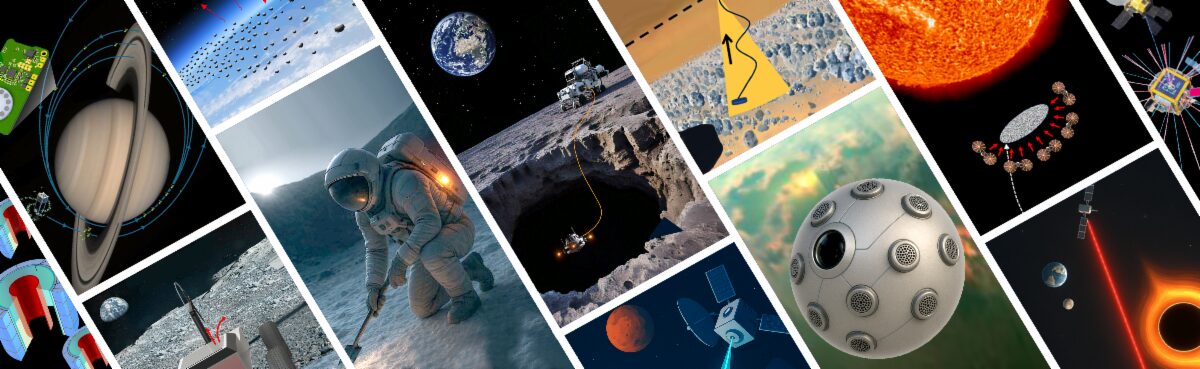
 (AGENPARL) - Roma, 30 Luglio 2026 - Il programma NASA Innovative Advanced Concepts (NIAC) ha creato 18 nuovi premi per sostenere idee visionarie volte a migliorare le tecnologie aerospaziali in settori che spaziano dall’esplorazione del sistema solare alla comprensione dell’universo.
I 18 finanziamenti della Fase I del NIAC ammontano a un totale di 3,2 milioni di dollari. Ciascun finanziamento prevede fino a 175.000 dollari per una fase di indagine iniziale della durata di nove mesi. I progetti del NIAC riguardano lo sviluppo di concetti in fase iniziale e non sono considerati missioni ufficiali della NASA.
“La NASA ha delineato una visione ambiziosa per il futuro dell’esplorazione spaziale: stiamo riportando la Luna sulla Terra, avanzando verso Marte e impegnandoci ad approfondire la nostra conoscenza dello spazio”, ha dichiarato Greg Stover, direttore della divisione Ricerca e Tecnologia Avanzata presso la Direzione Missioni di Ricerca e Tecnologia del quartier generale della NASA a Washington. “Raggiungere questi obiettivi richiederà ben più di un semplice progresso tecnologico incrementale. Significa che abbiamo bisogno di grandi balzi in avanti. Questi finanziamenti rappresentano il tipo di innovazione di cui il mondo ha bisogno che la NASA contribuisca a promuovere”.
In qualità di incubatore di innovazione, NIAC finanzia lo sviluppo iniziale di tecnologie potenzialmente rivoluzionarie. I progetti candidati al premio devono possedere sia un potenziale trasformativo sia una concreta fattibilità per una futura implementazione.
“Ogni innovazione, ogni progresso tecnologico, inizia con il seme di un’idea”, ha affermato Phillip Williams, responsabile ad interim del programma NIAC. “Il programma NIAC permette alla NASA di far germogliare questi semi e di determinare se c’è qualcosa che potrebbe essere sviluppato a beneficio delle future missioni spaziali e dell’economia aerospaziale del nostro Paese”.
Mentre la NASA e i suoi partner puntano a una presenza lunare stabile, alcuni dei vincitori del premio 2026 si sono concentrati su come contribuire all’esplorazione della Luna e alla costruzione di infrastrutture sul satellite. Tra questi, un sistema per supportare robot volanti in grado di esplorare i tunnel di lava sotto la superficie lunare, un metodo per gestire la temperatura di piccoli robot mobili per l’esplorazione e un sistema per integrare fonti di calore radioisotopiche nelle tute spaziali, al fine di mantenere al caldo gli astronauti durante le quasi due settimane di notte lunare.
Altri progetti si concentrano sull’esplorazione di alcune delle caratteristiche più straordinarie del sistema solare. Venere, con la sua atmosfera calda, rappresenta una sfida ardua per i veicoli di ricerca, pertanto uno dei vincitori del premio NIAC sta studiando metodi per rendere gli strumenti più resistenti e adatti a missioni di lunga durata.
Altri due concetti potrebbero essere utili per studiare gli anelli planetari. Il primo prevede l’utilizzo di uno sciame di 10.000 minuscoli satelliti per mappare e analizzare gli anelli di Saturno, mentre il secondo consisterebbe nella creazione di un sistema per raccogliere campioni da anelli come quelli che circondano Saturno, Urano e Nettuno.
Alcuni dei vincitori del premio NIAC guarderanno ben oltre il sistema solare, esplorando modi per alimentare veicoli spaziali interstellari, mappare i continenti sugli esopianeti, osservare gli anelli di fotoni attorno ai buchi neri e rilevare deboli onde gravitazionali per spiegare come si sono formate le galassie. Altri lavoreranno per rispondere a domande direttamente correlate alla vita sulla Terra, come il potenziale utilizzo della polvere spaziale per ridurre la radiazione solare e la consapevolezza riguardo ai detriti in orbita attorno alla Terra.
I ricercatori, noti come NIAC Fellows, analizzeranno le loro idee e individueranno potenziali sfide e opportunità per un ulteriore sviluppo.
I 18 progetti selezionati per i finanziamenti della Fase 1 del NIAC per il 2026 sono:
- Saptarshi Bandyopadhyay, NASA Jet Propulsion Laboratory, Pasadena, California: Oscuramento del Sole tramite nuvole di polvere controllabili per ridurre l’insolazione solare (DimSun)
- David Bugby, Jet Propulsion Laboratory della NASA: Architettura combinatoria che offre neomobilità, adattabilità su Venere e capacità di sopravvivenza (CANVAS)
- AC Charania, Zeno Power Systems, Inc., Washington:
- Attività extraveicolare estesa di radioisotopi da parte degli astronauti in paesaggi ghiacciati notturni e nello spazio profondo (EARENDIL)
- Anish Damodaran, Università della Florida Centrale, Orlando: PS21: Trasformare l’interferometria nello spazio submillimetrico con le tecnologie fotoniche
- Artur Davoyan, Università della California, Los Angeles: Vele solari impilabili e avvolgibili per missioni con delta-V molto elevato
- Daniel Drew, Università delle Hawaii, Honolulu: Propulsione a stato solido per la ricognizione autonoma del carsismo (SPARK)
- Gilly Elor, Stone Aerospace, Inc., Del Valle, Texas: Alimentazione tramite fibra ottica per abilitare un Lunar Underground eXplorer (LUX)
- Zhaoyan Liu, NASA Ames Research Center, Silicon Valley in California: Applicazioni del lidar quantistico per il vento nelle missioni di scienze planetarie e della Terra
- Jeff Nosanov, Orbital Velocity, LLC, Decatur, Georgia: OBLIVIAN: Osservazione della luce del buco nero tramite correlazione di intensità (OBLIVIAN)
- Keunhan Park, Università dello Utah, Salt Lake City: Generazione di energia termofotovoltaica a radioisotopi potenziata al plasmone (PRTPV) per missioni interstellari
- Austin Phoenix, Virginia Polytechnic Institute and State University, Blacksburg, Virginia: Isolatore lunare a conduttività variabile efficiente per il controllo ambientale passivo da parte di rilevatori (ECLIPSE)
- Marco Quadrelli, Jet Propulsion Laboratory della NASA: PRAXIS: Esplorazione autonoma degli anelli planetari con campionamento in situ (PRAXIS)
- Michael Rubenstein, Northwestern University, Chicago: Costellazioni di femtosatelliti a guida attiva per l’esplorazione in situ degli anelli, dell’atmosfera e della magnetosfera di Saturno.
- Benjamin Schafer, Rarefied Technologies Inc., Albuquerque, Nuovo Messico: Traccianti fotoforetici per il telerilevamento nello spazio vicino ad altitudini comprese tra 30 e 100 km.
- David Smith, Duke University, Durham, Carolina del Nord: Metamateriali elettromagnetici assemblati roboticamente per la consapevolezza della situazione spaziale a lungo raggio
- Pablo Sobron, Search for Extraterrestrial Intelligence Institute, Mountain View, California: Indagini sulle risorse di fionda intermondiale
- Paul Stankus, Brookhaven Science Associates, Upton, New York: Mappatura di continenti alieni: raggiungere la VLBI ottica per l’imaging di esopianeti
- Paul Stankus, Brookhaven Science Associates, Upton, New York: Astrometria di precisione mediante veicoli spaziali otticamente indipendenti per la rilevazione di onde gravitazionali
- **********
NASA Awards 2026 Innovative Technology Concepts
The NASA Innovative Advanced Concepts (NIAC) program has created 18 new awards to support visionary ideas to improve aerospace technologies in areas ranging from the exploration of the solar system to understanding the universe.
The 18 NIAC Phase I awards total $3.2 million. Each award provides up to $175,000 for a nine-month initial investigation. The NIAC projects are about early-stage concept development and are not considered official NASA missions.
“NASA has outlined an ambitious vision for the future of space exploration, we’re returning the Moon to stay, advancing to Mars, and pushing to deepen our understanding of space,” said Greg Stover, director of the Advanced Research and Technology division within the Research and Technology Mission Directorate at NASA Headquarters in Washington. “Achieving that will require more than incremental technological advancement. It means we need great leaps. These awards are the kinds of innovation the world needs NASA to help foster.”
As an innovation incubator, NIAC funds early development of potential breakthrough technologies. Concepts for award consideration must have both transformative potential and possible feasibility for eventual implementation.
“Every innovation, every leap in technology, starts with a seed of an idea,” said Phillip Williams, NIAC’s acting program executive. “The NIAC program allows NASA to germinate those seeds and determine if there’s something that could be grown to benefit future space missions and our nation’s aerospace economy.”
As NASA and its partners push for sustained lunar presence, some of the 2026 awardees focused on ways to help explore the Moon and build infrastructure there. These include a system to support hovering robots to explore lava tubes under the Moon’s surface, a method to manage temperatures for small mobile exploration robots, and a way to incorporate radioisotopic heat sources into suits to help keep astronauts warm when operating in the Moon’s nearly two-week-long lunar nights.
Other concepts focus on exploring some of the solar system’s most remarkable features. Venus, with its hot atmosphere, presents an imposing challenge for research vehicles, so one NIAC awardee explores methods for hardening instruments for longer missions.
Two other concepts could help study planetary rings. One would use a swarm of 10,000 tiny satellites to map and analyze the rings of Saturn, while another would create a system for collecting samples from rings such as those circling Saturn, Uranus, and Neptune.
Some NIAC awardees will look far beyond the solar system, exploring ways to power interstellar spacecraft, map out continents on exoplanets, observe the photon rings around black holes, and detect subtle gravitational waves to explain how galaxies formed. Others will work to answer questions directly related to life on Earth, like the potential use of spaceborne dust to reduce solar radiation, and awareness about the debris orbiting Earth.
Researchers, known as NIAC Fellows, will investigate their concepts and identify potential challenges and opportunities for further development.
The 18 selections for 2026 NIAC Phase 1 grants are:
- Saptarshi Bandyopadhyay, NASA Jet Propulsion Laboratory, Pasadena, California: Dimming the Sun Using Controllable Dust Cloud to Reduce Solar Insolation (DimSun)
- David Bugby, NASA Jet Propulsion Laboratory: Combinatory Architecture offering Neomobility, on-Venus Adaptability, and Survivability (CANVAS)
- A.C. Charania, Zeno Power Systems, Inc., Washington:
- Extended Astronaut Radioisotope-EVA in Nighttime and Deep-space Icy Landscapes (EARENDIL)
- Anish Damodaran, University of Central Florida, Orlando: PS21: Transforming Submillimeter Space Interferometry with Photonic Technologies
- Artur Davoyan, University of California, Los Angeles: Coilable Stacked Solar Sails for Very High delta-V Missions
- Daniel Drew, University of Hawaii, Honolulu: Solid-state Propulsion for Autonomous Reconnaissance of Karst (SPARK)
- Gilly Elor, Stone Aerospace, Inc., Del Valle, Texas: Power-over-Fiber to Enable a Lunar Underground eXplorer (LUX)
- Zhaoyan Liu, NASA Ames Research Center, California’s Silicon Valley: Quantum Wind Lidar Applications for Planetary and Earth Science Missions
- Jeff Nosanov, Orbital Velocity, LLC, Decatur, Georgia: OBLIVIAN: Observing Black hole LIght Via Intensity cOrrelatioN (OBLIVIAN)
- Keunhan Park, University of Utah, Salt Lake City: Plasmon-Enhanced Radioisotope Thermophotovoltaic (PRTPV) Power Generation for Interstellar Missions
- Austin Phoenix, Virginia Polytechnic Institute and State University, Blacksburg, Virginia: Efficient variable Conductivity Lunar Insulator for Passive Surveyor Environmental Control (ECLIPSE)
- Marco Quadrelli, NASA Jet Propulsion Laboratory: PRAXIS: Planetary Rings Autonomous EXploration with In-situ Sampling (PRAXIS)
- Michael Rubenstein, Northwestern University, Chicago: Actively Steerable Femtosat Constellations for In-situ Exploration of Saturn’s Rings, Atmosphere, and Magnetosphere
- Benjamin Schafer, Rarefied Technologies Inc., Albuquerque, New Mexico: Photophoretic Tracers for Near-Space Remote Sensing at 30-100 km Altitudes
- David Smith, Duke University, Durham, North Carolina: Robotically Assembled Electromagnetic Metamaterials for Long-Range Space Situational Awareness
- Pablo Sobron, Search for Extraterrestrial Intelligence Institute, Mountain View, California: Interworld Slingshot Resource Surveys
- Paul Stankus, Brookhaven Science Associates, Upton, New York: Mapping Alien Continents: Achieving Optical VLBI for Exoplanet Imaging
- Paul Stankus, Brookhaven Science Associates, Upton, New York: Precision Astrometry Using Optically Independent Spacecraft for Gravitational Wave Detection
*******************
NASA Awards 2026 Innovative Technology Concepts
The NASA Innovative Advanced Concepts (NIAC) program has created 18 new awards to support visionary ideas to improve aerospace technologies in areas ranging from the exploration of the solar system to understanding the universe.
The 18 NIAC Phase I awards total $3.2 million. Each award provides up to $175,000 for a nine-month initial investigation. The NIAC projects are about early-stage concept development and are not considered official NASA missions.
“NASA has outlined an ambitious vision for the future of space exploration, we’re returning the Moon to stay, advancing to Mars, and pushing to deepen our understanding of space,” said Greg Stover, director of the Advanced Research and Technology division within the Research and Technology Mission Directorate at NASA Headquarters in Washington. “Achieving that will require more than incremental technological advancement. It means we need great leaps. These awards are the kinds of innovation the world needs NASA to help foster.”
As an innovation incubator, NIAC funds early development of potential breakthrough technologies. Concepts for award consideration must have both transformative potential and possible feasibility for eventual implementation.
“Every innovation, every leap in technology, starts with a seed of an idea,” said Phillip Williams, NIAC’s acting program executive. “The NIAC program allows NASA to germinate those seeds and determine if there’s something that could be grown to benefit future space missions and our nation’s aerospace economy.”
As NASA and its partners push for sustained lunar presence, some of the 2026 awardees focused on ways to help explore the Moon and build infrastructure there. These include a system to support hovering robots to explore lava tubes under the Moon’s surface, a method to manage temperatures for small mobile exploration robots, and a way to incorporate radioisotopic heat sources into suits to help keep astronauts warm when operating in the Moon’s nearly two-week-long lunar nights.
Other concepts focus on exploring some of the solar system’s most remarkable features. Venus, with its hot atmosphere, presents an imposing challenge for research vehicles, so one NIAC awardee explores methods for hardening instruments for longer missions.
Two other concepts could help study planetary rings. One would use a swarm of 10,000 tiny satellites to map and analyze the rings of Saturn, while another would create a system for collecting samples from rings such as those circling Saturn, Uranus, and Neptune.
Some NIAC awardees will look far beyond the solar system, exploring ways to power interstellar spacecraft, map out continents on exoplanets, observe the photon rings around black holes, and detect subtle gravitational waves to explain how galaxies formed. Others will work to answer questions directly related to life on Earth, like the potential use of spaceborne dust to reduce solar radiation, and awareness about the debris orbiting Earth.
Researchers, known as NIAC Fellows, will investigate their concepts and identify potential challenges and opportunities for further development.
The 18 selections for 2026 NIAC Phase 1 grants are:
- Saptarshi Bandyopadhyay, NASA Jet Propulsion Laboratory, Pasadena, California: Dimming the Sun Using Controllable Dust Cloud to Reduce Solar Insolation (DimSun)
- David Bugby, NASA Jet Propulsion Laboratory: Combinatory Architecture offering Neomobility, on-Venus Adaptability, and Survivability (CANVAS)
- A.C. Charania, Zeno Power Systems, Inc., Washington:
- Extended Astronaut Radioisotope-EVA in Nighttime and Deep-space Icy Landscapes (EARENDIL)
- Anish Damodaran, University of Central Florida, Orlando: PS21: Transforming Submillimeter Space Interferometry with Photonic Technologies
- Artur Davoyan, University of California, Los Angeles: Coilable Stacked Solar Sails for Very High delta-V Missions
- Daniel Drew, University of Hawaii, Honolulu: Solid-state Propulsion for Autonomous Reconnaissance of Karst (SPARK)
- Gilly Elor, Stone Aerospace, Inc., Del Valle, Texas: Power-over-Fiber to Enable a Lunar Underground eXplorer (LUX)
- Zhaoyan Liu, NASA Ames Research Center, California’s Silicon Valley: Quantum Wind Lidar Applications for Planetary and Earth Science Missions
- Jeff Nosanov, Orbital Velocity, LLC, Decatur, Georgia: OBLIVIAN: Observing Black hole LIght Via Intensity cOrrelatioN (OBLIVIAN)
- Keunhan Park, University of Utah, Salt Lake City: Plasmon-Enhanced Radioisotope Thermophotovoltaic (PRTPV) Power Generation for Interstellar Missions
- Austin Phoenix, Virginia Polytechnic Institute and State University, Blacksburg, Virginia: Efficient variable Conductivity Lunar Insulator for Passive Surveyor Environmental Control (ECLIPSE)
- Marco Quadrelli, NASA Jet Propulsion Laboratory: PRAXIS: Planetary Rings Autonomous EXploration with In-situ Sampling (PRAXIS)
- Michael Rubenstein, Northwestern University, Chicago: Actively Steerable Femtosat Constellations for In-situ Exploration of Saturn’s Rings, Atmosphere, and Magnetosphere
- Benjamin Schafer, Rarefied Technologies Inc., Albuquerque, New Mexico: Photophoretic Tracers for Near-Space Remote Sensing at 30-100 km Altitudes
- David Smith, Duke University, Durham, North Carolina: Robotically Assembled Electromagnetic Metamaterials for Long-Range Space Situational Awareness
- Pablo Sobron, Search for Extraterrestrial Intelligence Institute, Mountain View, California: Interworld Slingshot Resource Surveys
- Paul Stankus, Brookhaven Science Associates, Upton, New York: Mapping Alien Continents: Achieving Optical VLBI for Exoplanet Imaging
- Paul Stankus, Brookhaven Science Associates, Upton, New York: Precision Astrometry Using Optically Independent Spacecraft for Gravitational Wave Detection
